

Alto de Letras is the world’s longest paved road climb by bicycle. Located in the Colombian Andes, it begins in Mariquita — a colonial town in the department of Tolima at 468 meters above sea level — and ascends without interruption to the Páramo de Letras, a high-altitude Tundra ecosystem at 3,663 meters. The 80-kilometer climb accumulates approximately 4,156 meters of elevation gain in a single, unbroken effort: no descents, no flats, no reset.
To put that in perspective, riding Alto de Letras is the equivalent of climbing Alpe d’Huez nearly three times over, back to back. The climb’s scale is so extreme that when the first “Vuelta Ciclista a Colombia” approached it in 1951, race organizers split it across two separate stages — because a single stage simply couldn’t contain it.
“To put that in perspective, riding Alto de Letras is the equivalent of climbing Alpe d’Huez nearly three times over, back to back”
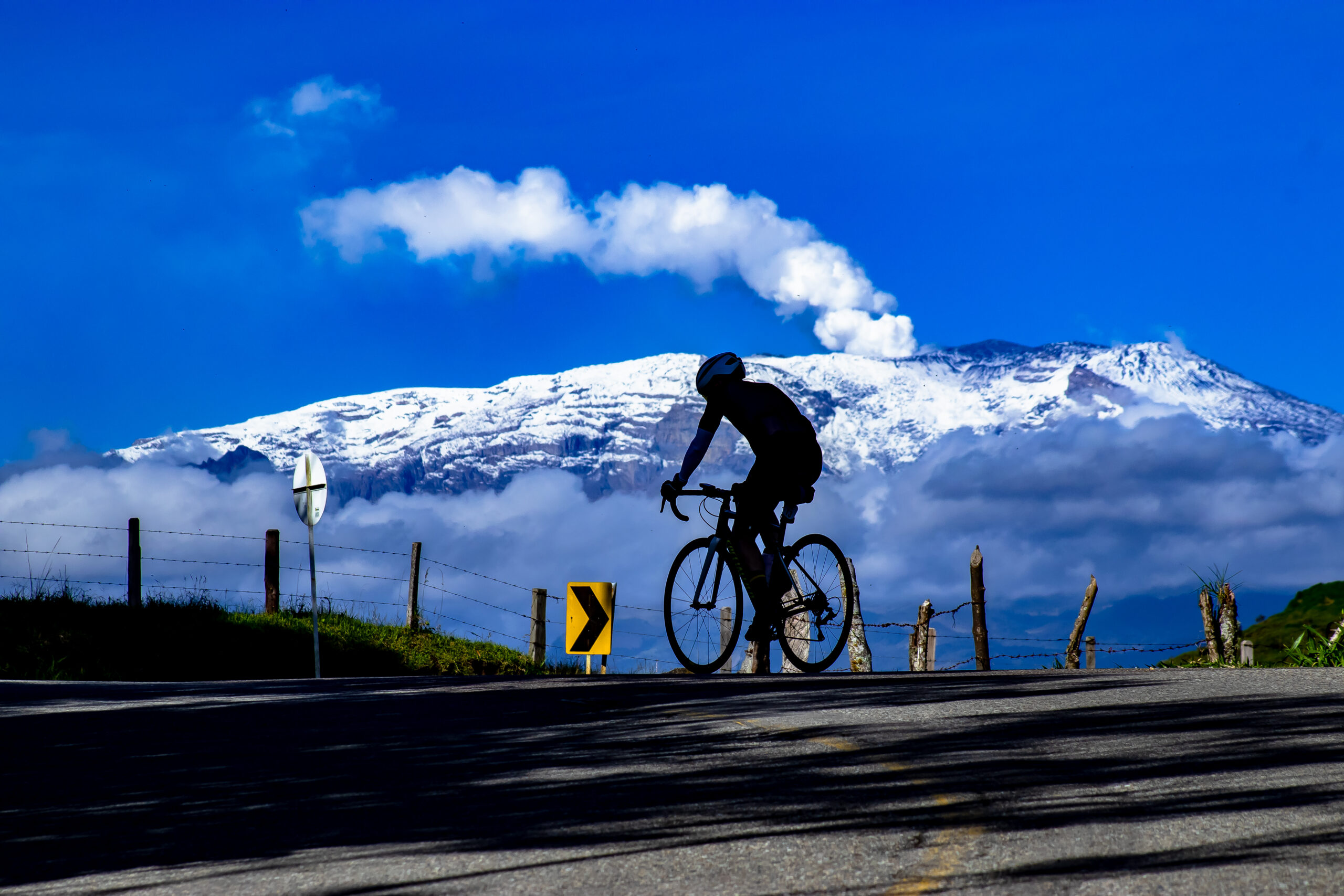
The Numbers Behind the Legend: Alto de Letras by the Data
The Alto de Letras begins in Mariquita, Tolima, at 468 meters above sea level and finishes at the Páramo de Letras pass at 3,663 meters — a total elevation gain of approximately 3,195 meters (gain 4,156/loss 962) across 80 kilometers of road. The published average gradient is 4%, a figure that significantly understates the lived experience: the majority of the route sustains between 6% and 9%, with ramps regularly exceeding 10% in the upper sections and a mind-blowing maximum grade of 32.2% where the road narrows toward the páramo.
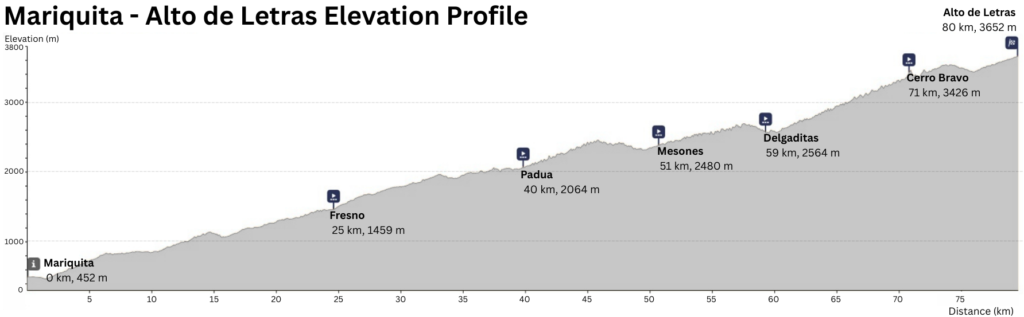
The climb’s racing history runs to the first Vuelta Ciclista a Colombia. When organizers approached Alto de Letras in 1951, they split it across two separate stages — the only practical way to incorporate it into a racing calendar. No single stage could contain the climb from base to summit.
The most celebrated modern ascent belongs to Santiago Botero — former Tour de France Mountains Classification winner and 2002 UCI Time Trial World Champion. In August 2007, Botero won the queen stage of the Vuelta a Colombia from Mariquita to Manizales, conquering Alto de Letras to retake overall race leadership. It remains among the most referenced performances in Colombian cycling history. (Source: Revista Mundo Ciclístico, El Tiempo — August 2007)
For riders tracking performance on Strava, the full segment “Alto de Letras desde Mariquita” (Segment ID: 16606124) records the complete 80-kilometer ascent. The leaderboard is one of the most meaningful benchmarks in endurance climbing — because on a climb this long, every position earned on that board was put there over hours, not minutes. (Source: Strava / VeloViewer)
Key Stats at a Glance
- Start: Mariquita, Tolima — 468 m above sea level
- Finish: Páramo de Letras — 3,663 m
- Distance: ~80 km (continuous ascent, no descents)
- Elevation Gain: ~3,195 m
- Average Gradient: 4% (sustained 6–9% across most of the route; 10%+ in upper sections)
- Max Grades: +32.2%/-16.7%
- Total Elevation Gain: ~4,156 m
- Total Elevation Lost: ~962 m
Strava Segment: Alto de Letras desde Mariquita
Velo Outside Magazine documented the ascent firsthand — and put the scale of it in terms no data table can fully capture. Read more here

The Escarabajos — Colombia’s Climbing Tradition and the Riders Who Made This Climb Famous
In Colombian cycling, a climber isn’t just a climber. They’re an escarabajo — a beetle. The nickname dates to 1952, when the newly created Vuelta Ciclista a Colombia produced a generation of riders who ascended impossible gradients with relentless, insect-like tenacity. The image stuck. Colombia’s mountain specialists became Los Escarabajos — beetles who crawl upward regardless of gradient, distance, or altitude. (Source: Wikipedia — Escarabajo; Scarab Cycles)
The tradition is historically documented. Luis Herrera (Lucho Herrera) became the first Colombian to win a Grand Tour stage and went on to win the Vuelta a España. Fabio Parra was the first Colombian to reach the Tour de France podium. Then came the modern generation — and with it, a sustained dominance of European climbing stages. Nairo Quintana won the Giro d’Italia in 2014 and the Vuelta a España in 2016, staging one of professional cycling’s defining rivalries against Chris Froome across back-to-back Tour de France editions in 2013 and 2015 — both times pushing the race to the final climbs. Egan Bernal completed the arc in 2019, becoming the first Colombian to win the Tour de France outright. What the Central Cordillera had been building for decades, the world’s biggest races finally confirmed. (Source: Pro Cycling Stats; colombia.co — Six Incredible Colombian Cyclists).
Outside Magazine explored exactly why the Colombian Andes keep producing the world’s best climbers. Read more here
Cordillera produces cyclists built for sustained effort at altitude. Santiago Botero’s 2007 queen stage performance from Mariquita to Manizales — ascending Letras at race pace — remains the benchmark that every serious Colombian climber knows by name. (Source: Revista Mundo Ciclístico, Pro Cycling Stats)
The Region You’ll Ride Through — Ecosystems, Gastronomy, and Culture
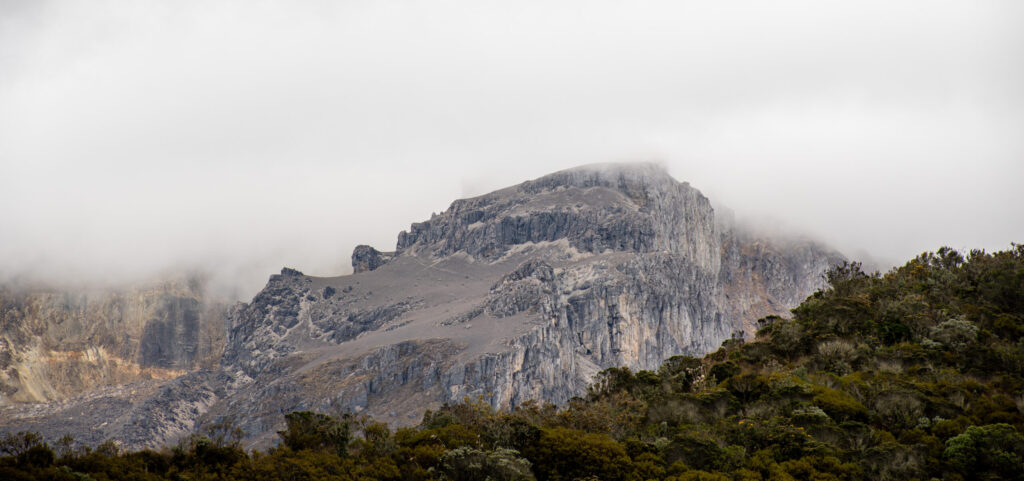
Alto de Letras is not a single landscape — it is four climate zones stacked on top of each other, each with its own temperature, vegetation, and character. The ascent is a full-day ecological transect through the Colombian Andes, beginning in the tropics and ending in the clouds.
The Alto de Letras climb begins in Mariquita — a colonial town founded by Spanish settlers in 1551 at the foot of the Central Andes, and one of Colombia’s oldest surviving municipalities. During the colonial era, it served as a mandatory transit point for westbound travel across the cordillera. By the late 1800s and early 1900s, it had become the principal collection hub for coffee beans harvested in the Eje Cafetero, transported down via a historic aerial cable car — an elevated gondola system that predated the ski resort infrastructure most riders today take for granted. From Mariquita, those beans continued their journey to Honda, the strategic port on the Magdalena River — Colombia’s main waterway connecting the interior and Bogotá with Barranquilla and Cartagena on the Caribbean coast.
At 468 meters above sea level, the start of the Alto de Letras cycling ascent is an assault on the senses before it is a challenge to the legs. The air is thick and tropical — average temperatures of 27–30°C (81–86°F). The lower road is flanked by ceibas, palm trees, and mango orchards, their canopy offering the last natural shade you’ll feel for hours. Tolima’s culinary tradition frames the sendoff, and it is among the most distinctive in Colombia: lechona (slow-roasted pork stuffed with rice, peas, and herbs, a preparation requiring 12–16 hours — crowned by TasteAtlas as the best dish in the world in 2025), tamal tolimense (pressed corn dough and filling, steamed in bijao leaves), and along the road, cholado — shaved ice layered with tropical fruit and condensed milk, the unofficial roadside fuel of Colombian cycling culture. (Source: ProColombia / colombia.travel)
By kilometer 30, the vegetation shifts, and with it the architecture, accent, and costumes of the people. Coffee farms and banana plantations give way to cloud forest. The air cools noticeably. You’re entering the lower edges of the Eje Cafetero — Colombia’s Coffee Region, a UNESCO World Heritage landscape spanning the departments of Caldas, Risaralda, and Quindío.
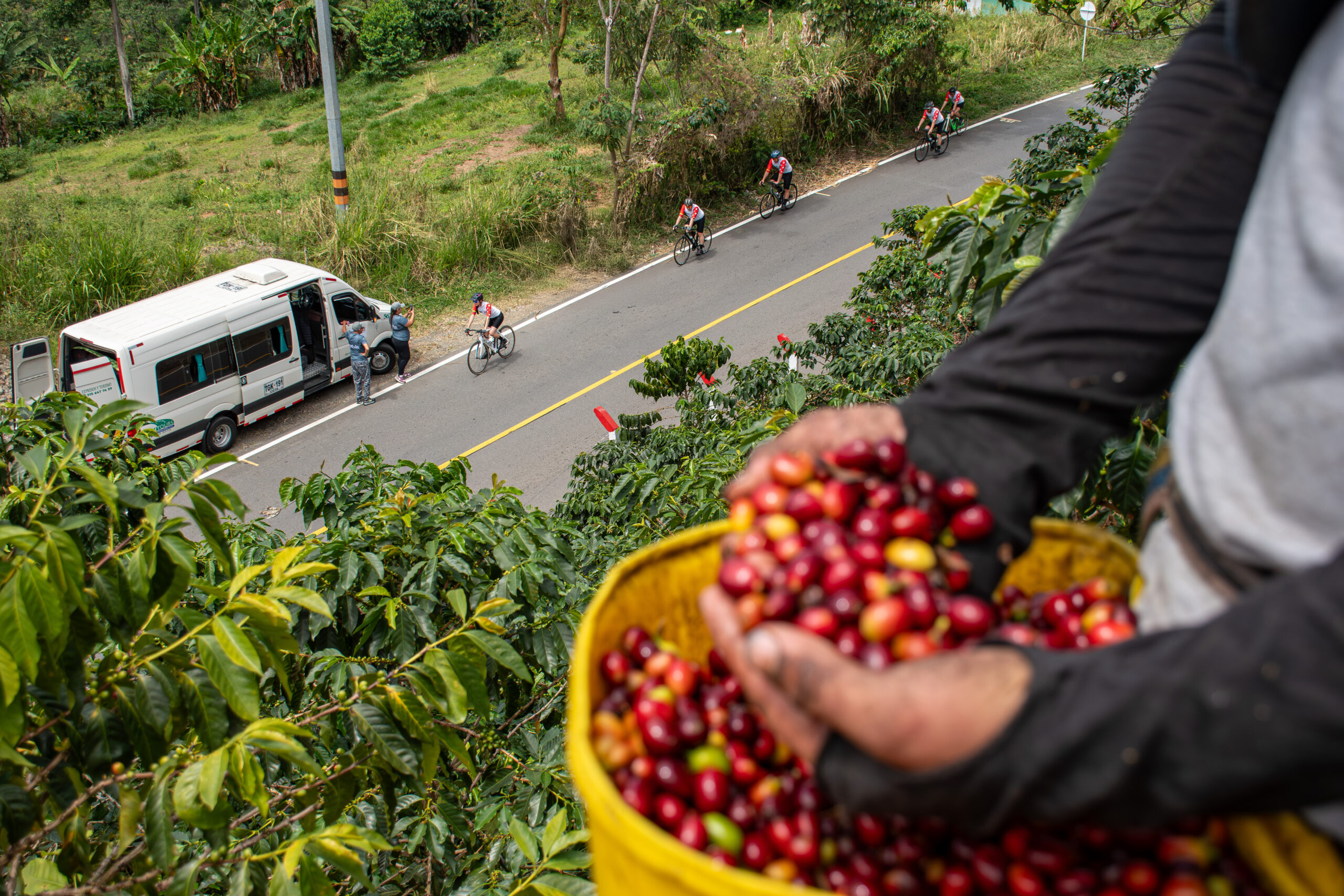
The coffee grown here is considered among the finest in the world for a precise combination of reasons that rarely converge elsewhere: volcanic soil enriched by the Central Andes, altitudes between 1,200 and 2,000 meters that slow the growth of the coffee cherry and concentrate its sugars, equatorial light filtered through natural cloud cover, and a bimodal rainfall calendar that allows two harvests per year. The result is a 100% Arabica bean with a flavor profile that has no equivalent at lower elevations — bright acidity, caramel sweetness, floral notes, and a clean finish that has made Colombian coffee a global benchmark.
Riding through it is a reward of its own. The road winds between rows of coffee plants shaded by banana and guamo trees, emerald hillsides dropping into deep ravines, and stretches of native guadua bamboo — one of the fastest-growing plants on Earth — arching overhead like a natural tunnel. The air at 1,500 meters is cool and clear. The gradient is still climbing. The landscape earns every pedal stroke.
By kilometer 55, you’ve entered the high Andean zone of Alto de Letras. The road narrows. The gradient stiffens — this final push, known locally as Las Delgaditas, averages 7% over 14 kilometers beginning at 3,000 meters, and it is the section that defines every Alto de Letras cycling attempt. Everything before this point has been preparation. The dwarf bamboo gives way to open moorland, mosses carpet the roadside, and the first frailejones appear: those ancient, centuries old, spiky sentinels of the Colombian páramo, some reaching over two meters tall, their dense woolly rosettes evolved over millennia to pull moisture directly from passing clouds.
On clear mornings — and conditions at this altitude are famously unpredictable — the snow-capped summit of Nevado del Ruiz appears to the left: Colombia’s most iconic active volcano, rising to 5,321 meters, part of the Los Nevados National Natural Park. It is the kind of view that stops the pedaling for a moment whether you planned to or not.
At 3,663 meters, you arrive at what every alto de letras cycling guide points to as the defining moment of the ride: the Páramo de Letras — a treeless, fog-wrapped alpine ecosystem found exclusively in the northern Andes, where silence is broken only by wind and the sound of your own breathing.
When — and if — you make it to the top, savor every second of it. Drink in the silence, the altitude, the view stretching out over the Magdalena Valley. You’ll be running on fumes — and that’s exactly as it should be, because this is what months of training were for. Alto de Letras cycling doesn’t reward the fittest riders. It rewards the most stubborn ones. You’ve tamed the beast. Take every photo. Breathe every second of it in. That summit, and everything it took to reach it, is yours forever.
The Washington Post made the case directly: Colombia is worth the trip. Read more here
Where BEYOND THE RIDE Riders Begin the Ascent: Casa de Campo la Giralda
Rest and recovery are as important as training for athletes of all ages and levels. So, before the first kilometer of Alto de Letras, there is the question of where you will stay and recover. Casa de Campo La Giralda — an unrivaled estate in the Mariquita area — has been in Beyond The Ride’s family for three generations. Originally built as a working country property, it has evolved into one of the few accommodations in the region specifically designed for cyclists conquering the ascent.
Different to any other hotel, our property provides exactly what a serious cycling environment requires: calm, open, shared spaces that foster camaraderie with your fellow cyclists, a country-house rhythm that gives your family and non-rider companions their own space and activities, and the kind of proximity to the road that eliminates logistical friction. Casa de Campo La Giralda sits at the foot of the climb — meaning your route briefing, equipment check, and first pedal stroke all happen on the road to Alto de Letras itself. It is the base of operations for all Beyond The Ride guests on the Alto de Letras Challenge and the starting point of our Land of Coffee tours, included as part of the all-inclusive package.
Why rest and recovery is essential for athletes – UCHealth Today
Alto de Letras vs. The World’s Most Famous Climbs
Cyclists who have ridden in Europe naturally reach for reference points. Alpe d’Huez is 21 hairpin bends and 14 kilometers burned into Tour de France mythology. The Col du Tourmalet is the most-climbed pass in Tour history, with over 87 appearances. They are the benchmarks by which serious climbers measure mountain cycling.
Alto de Letras doesn’t fit those benchmarks — it reshapes them. The table below compares verified climb data across all three. (Sources: climbfinder.com for Alpe d’Huez and Col du Tourmalet; pjammcycling.com and The Climbing Cyclist for Alto de Letras).
| Metric | Alto de Letras (Colombia) | Alpe d’Huez (France) | Col du Tourmalet (France) |
| Distance | ~80 km | 14 km | 17.2 km |
| Elevation Gain | ~3,195 m | 1,122 m | 1,268 m |
| Starting Elevation | 468 m (Mariquita) | 719 m | 847 m |
| Summit Elevation | 3,663 m | 1,841 m | 2,115 m |
| Avg. Gradient | 4% | 8% | 7.4% |
| Max. Gradient | 32.2% | 13% | 12% |
| Sustained Gradient | 6–9% (most of climb) | 8% avg | 7–8% avg |
| UCI Category | Beyond Category | Hors Catégorie | Hors Catégorie |
| Tour de France | N/A | 30+ finishes | 87+ finishes |
| Elite Riding Time | 2:51 minutes (record by Santiago Botero) | ~38–42 min | ~50–55 min |
What the numbers don’t capture: Alpe d’Huez and the Tourmalet are finished in under an hour by elite riders. Alto de Letras will take three to four hours to elite riders to complete and between 5 to 6 to amateur cyclists — continuous exposure to heat, altitude accumulation, and sustained output. It is not a harder version of a European climb. It is a categorically different kind of effort.
Inserto de CTA Planning to ride Alto de Letras with full logistical support — daily sport massage, boutique accommodation, bilingual guide, and a team that has done this climb dozens of times? View Beyond The Ride’s Alto de Letras Challenge →
Riding Into the Clouds — Climate Zones, Altitude, and the Páramo de Letras
For cyclists from Europe, North America, or Australia, what happens on the upper half of Alto de Letras is genuinely unfamiliar. There are no seasons here in the European sense — but there are daily climate cycles that compress an entire continental range into a single ride.
At the base in Mariquita: 27–30°C, tropical humidity. By kilometer 40: 15–18°C, the air noticeably thinner. By kilometer 65, you’re climbing through mist. At the summit: 4–10°C, with wind, fog, and the real possibility of precipitation — even during what locals describe as dry season. The temperature differential between start and finish is reliably 20–25°C. No Alpine or Pyrenean climb produces a range close to that. (Source: IDEAM — Instituto de Hidrología, Meteorología y Estudios Ambientales de Colombia; colombia.co — Mountain Climates)
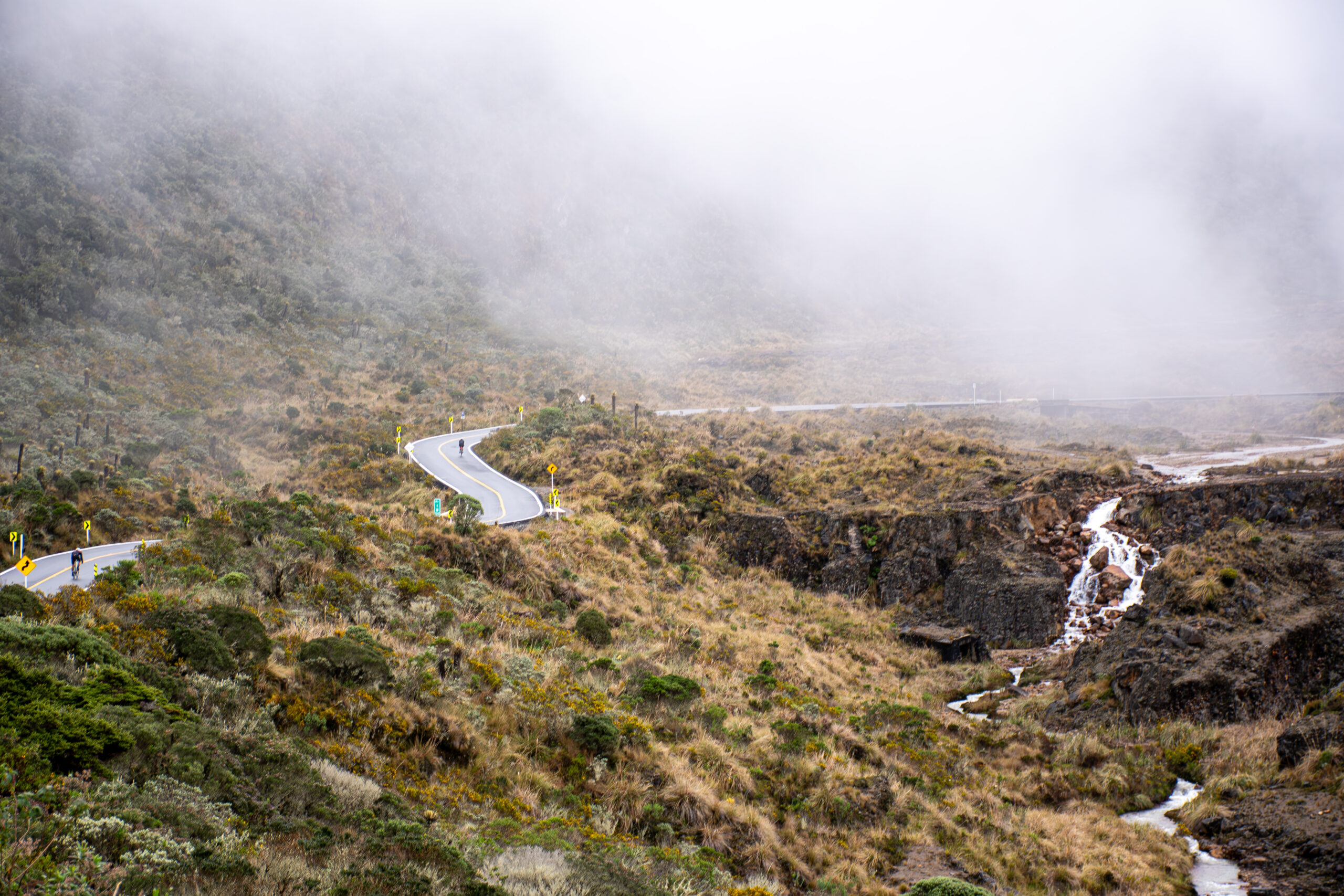
The Páramo de Letras, which you reach at the summit, is a high-altitude ecosystem found exclusively in the northern Andes, in an elevation band between approximately 3,000 and 4,500 meters. Its defining plant is the frailejón (Espeletia spp.) — a tall, spiky, succulent-like species that functions as a living atmospheric sponge, capturing moisture from the cloud layer and releasing it slowly into the soil below. The páramo feeds Colombia’s rivers and serves as one of the most critical freshwater ecosystems on the planet. Arriving there at the end of 80 kilometers feels — and looks — like riding onto another world entirely. (Source: The Nature Conservancy — Colombia’s Paramos; Columbia Earth Institute, 2018)
Practical note for gear: riders who begin the ascent in a short-sleeve jersey will need a packable rain jacket and arm warmers for the summit. The weather app will show 'sunny' for Mariquita. Bring the jacket anyway. This is the kind of detail that separates cyclists who have ridden Colombia from those who have only read about it — and exactly the kind of variable that Beyond the Ride removes from the equation entirely. On a Beyond The Ride tour, a support vehicle follows the group from base to summit carrying extra layers, jackets, nutrition, and pro mechanical support. Pre-climb briefing, gear logistics, food and hydration at the right kilometer— it's all handled. Your only job on the day of the climb is the effort itself. In professional cycling, the rider who anticipates everything you need before you think to ask is called a Domestique. Beyond the Ride is yours.
“There’s no lying on Alto de Letras. Eighty kilometers doesn’t let you fake fitness. What it gives back is a top-of-the-world feeling that no European climb can replicate — you earn it differently here.”
David Giraldo, Beyond the Ride Host
Ready to ride Alto de Letras with full support? Beyond The Ride’s Alto de Letras Challenge includes airport transfers, single accommodation at Casa de Campo La Giralda, daily sport massage, bilingual guide, premium road bike, meals, hydration and support on route, and a team that knows every kilometer of this climb. View the complete Alto de Letras Challenge itinerary →
Sources
- Cycling Destination — Alto de Letras: Dream Destination
- pjammcycling.com — Alto de Letras: Cycling Data & Info
- Revista Mundo Ciclístico — Botero wins Vuelta Colombia 2007 queen stage
- El Tiempo — Botero stage 6 Vuelta Colombia 2007 (archived)
- Wikipedia — Escarabajo (cycling nickname and history)
- Scarab Cycles — Escarabajos: Colombia’s Climbing Heritage
- Colombia Country Brand — Six Incredible Colombian Cyclists Excelling on the World Stage
- ProColombia / colombia.travel — Best Cycling Routes in Colombia
- Wikipedia — Mariquita, Tolima
- climbfinder.com — Alpe d’Huez: Full Climb Profile
- climbfinder.com — Col du Tourmalet: Full Climb Profile
- colombia.co — Colombia’s Diverse Mountain Climates
- IDEAM — Instituto de Hidrología, Meteorología y Estudios Ambientales de Colombia
- The Nature Conservancy — Colombia’s Paramos: Natural Climate Solutions
- Columbia Earth Institute — This Unique Andean Ecosystem is Warming Almost as Fast as the Arctic
- VeloViewer — Strava Segment: Alto de Letras desde Mariquita (ID 16606124)