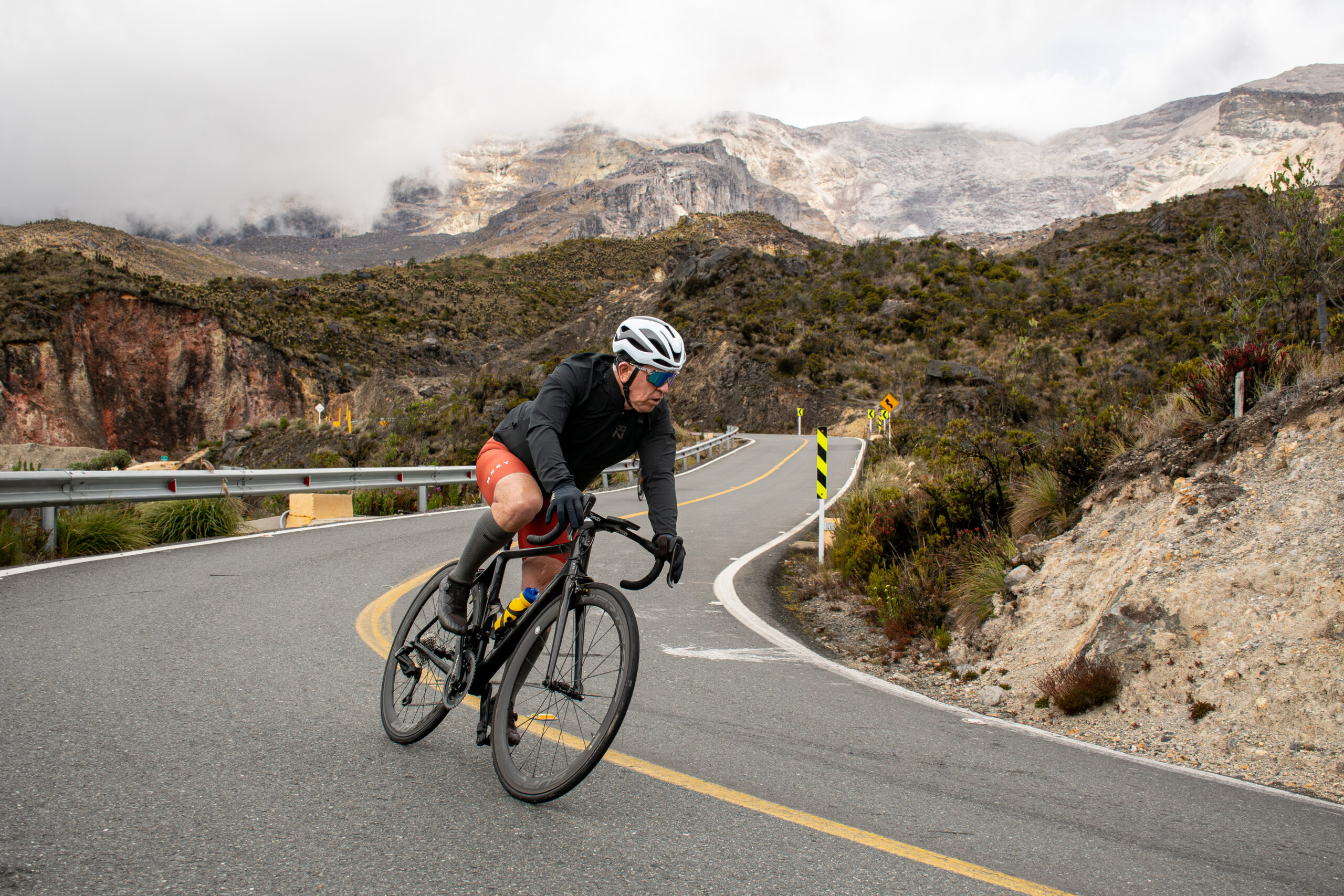
How do you train for Alto de Letras? Ask a cyclist who’s finished it and the first thing you’ll hear isn’t a number — it’s a warning: whatever ‘ready’ feels like in your head, add a few more hours to it. Alto de Letras never flattens — 80-plus kilometers of continuous ascent, from the tropical heat of Mariquita at 468 meters to the cold páramo at 3,663 meters, with no descent to recover on anywhere in between. Training for it means building an engine that holds output for four to five hours straight, adapts to a 20°C-plus swing in temperature, and still functions above 3,000 meters. Here’s the eight-week plan that gets you there..
This plan assumes you’re already riding regularly and comfortable with 60–80 km outings, with at least eight weeks before departure. It won’t turn a beginner into a mountain specialist — it will sharpen an already-fit cyclist for this ascent’s specific demands: aerobic output, heat, and altitude. For the full technical breakdown — gradient by section, elevation profile, climate zones — see Beyond The Ride’s complete guide to Alto de Letras. This article covers getting your legs, lungs, and pacing ready for it.
How to Train for Alto de Letras: The 8-Week Framework
The plan breaks into four two-week blocks, each with a specific job. Weeks 1–2 build aerobic base and establish a fitness baseline. Weeks 3–4 add threshold intervals and climbing-specific strength. Weeks 5–6 are where the climb-specific work happens: heat exposure, altitude preparation, and back-to-back long rides that simulate three-plus hours of sustained output. Weeks 7–8 taper volume while sharpening pacing and ride-day logistics. The through-line across all eight weeks: duration beats intensity, and specificity beats volume. A rider who can hold 70% of Functional Threshold Power (FTP) for four hours will out-climb a rider with a higher FTP who has never ridden past 90 minutes.
If eight weeks from now you want to be standing at the summit instead of still talking about it, Beyond The Ride's Alto de Letras Challenge is the fully guided, all-inclusive week built around this exact ascent — support vehicle, bilingual guide, every cost itemized upfront, no hidden fees. → Alto de Letras Challenge
Weeks 1–4: Building the Aerobic Engine
Nobody brags about week one on Strava. Do it anyway. Build a strong aerobic base with most rides in Zone 2, plus one long weekend ride every week so you can hold several hours of steady pedaling without fading. Alto de Letras is less about explosive power and more about staying smooth, patient, and efficient for a very long time. In weeks 3–4, add climbing-specific work: low-cadence hill repeats (50–60 rpm) to build leg torque and fatigue resistance, plus threshold or over-under intervals to prepare for the repeated ramps and short recoveries that define the climb. That combination — torque under load, then controlled surges — is what keeps you composed when the gradient changes, instead of burning your matches in the first two hours.
Weeks 5–6: Heat, Altitude, and the Climbing Days That Actually Matter
This is where alto de letras cycling stops resembling a normal training block. Heat acclimatization is trainable: a peer-reviewed study of cyclists training in roughly 37°C conditions found time-trial performance improved from 77 minutes on day one to 66 minutes by day 14 — nearly matching cool-weather performance (PMC / National Institutes of Health, 2015). You don’t need a heat chamber — ride during the hottest part of the day, layer clothing on the trainer, or use a sauna post-ride, three to four sessions across the two weeks.
Altitude is the piece that scares people most — usually because of stories about a “monster” climb that flattens anyone who shows up unacclimatized. Altitude physiology actually offers two workable strategies: arrive 4–6 days early and let your body clear the worst of the acute phase before pushing hard, or arrive within about 24 hours, do the hard effort, and leave before symptoms peak on days 2–3. Beyond The Ride runs the second approach — and it works because exposure is short: on the Alto de Letras Challenge, you’re above 2,500 meters for a maximum of about four hours, on summit day itself. USA Cycling notes the worst window for altitude symptoms is 24–48 hours after arrival, before adaptation has kicked in — which lines up with why the route is timed to move through that window quickly rather than sit inside it. Close your own training block with the longest ride yet: 4–5 hours, back-to-back if possible, at a pace you could sustain for a full day. That’s the fitness half of the equation. Keeping your altitude exposure short is the other half — and that part is already built into the route.
“Riders show up expecting a monster — 80-plus kilometers, over 3,000 meters of climbing, thin air at the top,” says David Giraldo, Beyond The Ride Brand Director.
Every departure is built around that experience — a route timed to keep altitude exposure short, and pacing knowledge that barely exists anywhere else in Latin America’s cycling-tourism market. It’s one of the reasons the roads here still feel like a discovery instead of a tourist circuit.
Weeks 7–8: Taper, Pacing, and Getting Ride-Day Ready
Volume drops by roughly 40–50% in week 7 and further in week 8, while intensity stays sharp — short efforts at threshold keep the legs responsive without adding fatigue. Use this block to rehearse pacing, not just fitness: Alto de Letras rewards a negative split by climate zone, not by kilometer. Ride the first third — the tropical lower slopes — at a deliberately conservative effort, save your matches for the cooling middle section, and expect the final climb into the páramo to feel harder than the power numbers suggest, since thinner air and dropping temperatures both tax output. Sleep becomes the priority metric in these two weeks — aim for consistency over heroics. Nothing new on ride day: no new saddle, no new nutrition, no new tire pressure. And sleep, sleep a lot!
Training Indoors When You Live Somewhere Flat: The Houston Cyclist’s Guide to Rollers and Smart Trainers
If you live in Houston — or anywhere else without a hill worth naming — this block isn’t optional, it’s the plan. A smart trainer solves a problem flat outdoor terrain can’t: it removes coasting entirely. Every pedal stroke, every recovery interval, happens under load, which Cycling Weekly has noted makes indoor climbing simulation genuinely transferable to real mountains, not just a fitness substitute. Set your trainer’s simulated gradient to 6–8% and hold structured intervals there instead of chasing flat-road speed. Two sessions a week of 45–75 minutes at climbing cadence (60–75 rpm) will build more climbing-specific strength than 150 flat outdoor kilometers. Combine that with one long weekend ride outdoors for time-in-saddle and heat exposure — Houston’s summer humidity is, unintentionally, decent altitude-adjacent heat training. Turn the fan off for the last 20 minutes of a hard trainer session and you’ve replicated more of Alto de Letras’s thermal stress than most European climbers experience in a season.
Fueling an 81-Kilometer Climb: Carbohydrate and Hydration Strategy
A four-hour continuous effort empties glycogen stores in a way a 90-minute ride never does — fuel aggressively. In the days before the ride, eat a high-carbohydrate diet to top off glycogen stores, and on the bike, aim for consistent carbohydrate intake throughout the effort rather than catching up once you feel empty. For long, hard climbing at altitude, the literature supports high carb availability: endurance guidance from CTS / TrainingPeaks puts general needs at roughly 60–90 grams per hour for rides this long and this hard, and altitude-specific research from the Gatorade Sports Science Institute notes daily carbohydrate needs can climb sharply at elevation, since altitude raises the carbohydrate cost of the same effort. Keep it simple on the bike: easy-to-digest foods, regular sips rather than large gulps, and fueling on a schedule — never waiting until you feel hungry or empty. A steady pace, the right gearing, and disciplined fueling matter more than attacking the climb early. Practice the exact strategy — same brand of gel, same bottle mix — on your long training rides; gut tolerance is trainable, and ride day is the wrong day to discover it isn’t. If you’re unsure whether your current fitness matches this specific ascent, Beyond The Ride’s FAQ page breaks down what a typical day on the climb actually demands.
Recovery Routine for Multi-Day Cycling Trips
Training gets you to the start line. Recovery is what lets you show up for day two, three, and four just as strong — especially on a multi-day itinerary like the Alto de Letras Challenge or The Land of Coffee. After each ride, spend 10 minutes cooling down instead of stopping suddenly, then refuel with carbohydrates plus protein as soon as possible. Keep hydrating through the afternoon and evening, adding electrolytes if you’ve sweated heavily. Follow with 5–10 minutes of mobility work for the hips, quads, hamstrings, calves, and lower back — light foam rolling, an easy recovery spin, or a short walk all help reduce next-day stiffness. Sleep is the biggest recovery tool of all: get to bed early and go easy on alcohol. The goal each night isn’t to feel perfect — it’s to arrive at the next ride with enough energy, fluid, and mobility to keep going.
On the Alto de Letras Challenge, most of this is already handled for you. Every riding day includes a 30 minute sport massage as part of the recovery protocol — not a spa add-on — and the morning after the summit push is an intentionally easy ride, built to flush lactic acid and restore range of motion before the second climb, Alto El Sifón, two days later. All five nights on route are spent at the same base, Casa de Campo La Giralda, at kilometer zero of the climb, with breakfast, lunch, and dinner included and a pool to put your legs up in before the next stage. Recovery isn’t something you have to plan around here — it’s already on the itinerary.
Ready to Put the Plan on the Road?
Eight weeks of structured training gets you fit enough for Alto de Letras. You bring the fitness. We handle everything else.

Ready to ride? → Alto de Letras Challenge